In today’s fast-evolving manufacturing landscape, high-mix, low-volume (HMLV) producers face unique challenges. From managing complex product configurations to ensuring compliance and traceability, maintaining quality without sacrificing efficiency is no small feat.
Enter the digital thread—a transformative concept that connects every stage of the manufacturing process with real-time data collection, creating a seamless flow of information, embedded in your electronic work instructions / build processes. In this article, ProcessIQ explores how the digital thread enables manufacturers to achieve excellence, reduce errors, and stay ahead of competitors.
What’s the Story?
This indusrty Insight delves into the concept of the digital thread and its role in revolutionising quality systems for discrete, high mix / low volume manufacturing.
We’ll cover:
- The definition and importance of the digital thread.
- How it enhances quality and traceability.
- Practical benefits for manufacturers, including real-world applications.
- How ProcessIQ’s MES platform leverages the digital thread to empower manufacturers.
- Key takeaways for building a future-ready quality system.
Understanding the Digital Thread in Manufacturing
The digital thread is a continuous, integrated flow of data that links every phase of the manufacturing lifecycle—from design and engineering to production, assembly, and quality assurance. Unlike traditional systems where data silos create gaps, the digital thread ensures that information is accessible, accurate, and actionable across the shop floor and beyond. For HM/LV manufacturers, where product variability is high, this connectivity is critical to maintaining consistency and quality.
Why Quality Systems Matter in High Mix /Low Volume Manufacturing
In configure-to-order industries like photonics, lasers, or energy solutions, product and therefore production variability is common please. Each product may have many unique specifications or variances, making the management of build process and quality control a complex task and time-consuming task.
Manual processes, such as paper-based build instructions and quality travellers, often lead to errors, delays, and compliance risks. One of the undervalued parts of the digital thread, as it pertains to quality is contemporaneous recording.
Vital to quality because it captures information at the moment work is performed, preserving context, accuracy, and intent. Timely entries reduce recall bias, prevent back-dating and quiet edits, and create a trustworthy chain of evidence for audits and investigations. This immediacy strengthens traceability and accountability, enabling faster, more reliable root-cause analysis and corrective actions. In short, documenting as you go safeguards data integrity and ensures decisions are grounded in real, not reconstructed, conditions.
A robust quality system, powered by a digital thread, addresses these challenges by providing real-time data capture, automated checks, and traceable records.
The Role of the Digital Thread in Quality
The digital thread transforms quality systems in several ways:
- Real-Time Data Capture: By aligning specifications to production processes, the digital thread ensures that every build meets your exacting standards. Deviations are flagged instantly, building quality in, reducing scrap and rework.
- Enhanced Traceability: Every operation, every step is documented digitally. This creates an auditable trail, essential for compliance with industry standards like ISO or FDA regulations.
- Error Reduction: Confirgurable work instructions, updated in real time, eliminate ambiguity and human error, ensuring operators are being presented with clear, concise and accurate procedures.
- Predictive Insights: By analysing data across builds and production cycles, manufacturers can identify issues and patterns, predict quality issues, and implement preventive measures.
For example, a photonics manufacturer using a digital thread in production can track a key critical to quality measurement limits ensuring any wild variance outise of limits is caught, triaged, disposed and corrected, ensuring the final product does not end up as scrap or even worse, recalled. This level of precision is a game-changer in industries where critical specification and quality data need to be met.
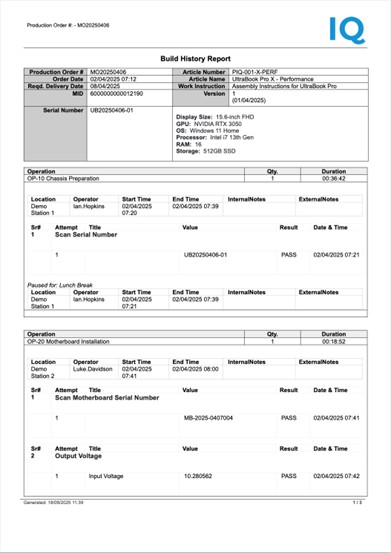
Product Build History capturing an auditable end to end build process.
Real-World Impact
Consider a small manufacturer producing custom energy solutions. Without a digital thread, quality checks rely on manual inspections and paper records, leading to missed defects and costly recalls. By adopting a digital thread, the same manufacturer can integrate quality data with production processes, enabling real-time monitoring and integrated corrective actions. Studies show that manufacturers using digital threads can reduce quality-related costs by up to 20% while improving delivery times.
How ProcessIQ Can Help You for the Same
ProcessIQ’s Manufacturing Execution System (MES) is designed to bring the digital thread to life for high mix / low volume discrete manufacturers where there is a high degree of variability. Here’s how it supports robust quality systems:
- Integrated Electronic Work Instructions: ProcessIQ replaces paper-based build documentation with dynamic, digital instructions that update in real time, ensuring operators are presented with accurate build and quality processes reducing errors on the shop floor.
- Seamless Data Integration: ProcessIQ connects shop floor data with enterprise resource planning systems, creating a unified digital thread that tracks and links production orders with every step of production, providing full traceability.
- Variance Management: ProcessIQ’s unique configurator allow manufacturers to manage product and process variability with ease, ensuring quality remains consistent across all configurations.
- Microsoft PowerBI: Connect your production data to Microsoft’s PowerBI delivering powerful insights to validate your planned vs actual assumptions.
- Modular Scalability: ProcessIQ allows manufacturers to start small and scale as needed, embedding quality into every growth phase.
By implementing ProcessIQ, a laser equipment manufacturer ensures that every built unit meets stringent quality standards, with every process step documented for compliance.
The platform’s quick deployment—often within weeks—means manufacturers can start reaping the benefits of a digital thread without lengthy disruptions.
Here’s an SEO-optimized FAQ section for your blog “Digital Thread in Manufacturing” (https://processiq.io/digital-thread-in-manufacturing/
) designed to:
✅ Target key search queries
✅ Improve relevance for digital thread in manufacturing
✅ Capture “People Also Ask” snippets
✅ Increase dwell time and long-tail rankings
You can add this at the end of the article and markup with FAQ schema for SERP enhancements.
Frequently Asked Questions
What is a digital thread in manufacturing?
A digital thread in manufacturing is a connected data framework that links information across the entire product lifecycle—from design and engineering to production, quality, and service. It ensures seamless flow of data between systems like CAD, ERP, MES, and quality tools, enabling real-time visibility, traceability, and decision-making.
Why is the digital thread important in manufacturing?
The digital thread is important because it eliminates data silos, accelerates process insights, improves product quality, and enables greater operational efficiency. By creating a single source of truth, manufacturers can reduce errors, optimize workflows, and respond faster to production challenges.
How does a digital thread improve manufacturing operations?
A digital thread improves manufacturing operations by linking design, engineering, production, and quality data. This real-time connectivity supports better decision-making, faster root-cause analysis, reduced rework, and improved compliance. Manufacturers gain end-to-end visibility and actionable insights across the product lifecycle.
What technologies enable the digital thread in manufacturing?
Key technologies that enable the digital thread include cloud platforms, IoT sensors, ERP and MES systems, PLM software, advanced analytics, and process intelligence tools. Together, these technologies integrate data from different sources and deliver unified insights.
What is the difference between digital thread and digital twin?
A digital thread connects data across lifecycle stages, creating a continuous information flow. A digital twin is a virtual model of a specific asset or process that uses that data to simulate performance. The digital thread provides the data foundation, while the digital twin provides actionable simulations.
How does the digital thread support quality management and compliance?
The digital thread enables consistent tracking of quality data, audit trails, and process records. By linking quality events to process data and product history, manufacturers can ensure compliance with industry standards like ISO, FDA, and automotive regulations, and reduce quality risks.
Can small and medium manufacturers benefit from a digital thread?
Yes. The digital thread is scalable and beneficial for manufacturers of all sizes. Even small and medium manufacturers can gain efficiency, visibility, and quality improvements by connecting their core systems and workflows through a digital thread.
What role does process intelligence play in the digital thread?
Process intelligence enhances the digital thread by turning connected data into actionable insights. Tools like ProcessIQ help manufacturers visualize real workflows, identify bottlenecks, and optimize operations by linking quality, production, and performance data across the digital thread.
What industries benefit most from digital thread adoption?
Industries that benefit significantly include aerospace, automotive, electronics, pharmaceuticals, and medical devices. These sectors require high levels of traceability, compliance, and complexity management, making the digital thread especially valuable.
How do manufacturers get started with implementing a digital thread?
To implement a digital thread, manufacturers should:
- Assess current systems and data silos
- Define key use cases and business goals
- Integrate core systems (ERP, MES, PLM, IoT)
- Establish centralized data models
Use advanced analytics and process intelligence tools like ProcessIQ to connect and optimize workflows
Conclusion
In closing, the value of a Digital Thread is realized when every step—from requirements to service—flows through a single, governed narrative of truth. ProcessIQ.io fits as the execution-and-evidence layer in that narrative: it captures contemporaneous human and machine activity, ties it to configurations and revisions, and pushes clean, contextualized records back into PLM/MES/ERP via open integrations.
By turning procedures into traceable workflows with approvals and automated data collection, ProcessIQ closes the loop between intent and actuals, accelerating investigations and compliance while feeding design and manufacturing with trusted feedback.
The result is a living thread that not only connects data, but continuously improves it, linking decisions to outcomes and shortening the path from insight to action.