The Need for Smarter Manufacturing
In today’s fast-evolving industrial landscape, manufacturers are under increasing pressure to improve productivity, reduce costs, and maintain consistent product quality. Manufacturing software has therefore become a critical tool for businesses looking to stay competitive and efficient. However, many organisations still rely on manual processes, spreadsheets, or disconnected systems, which often lead to delays, errors, and limited visibility across operations.
At the same time, customer expectations are rising, and supply chains are becoming more complex. As a result, manufacturers need real-time insights into production, inventory, and performance to make informed decisions quickly. Without accurate data and streamlined workflows, even well-planned operations can face bottlenecks, downtime, and inefficiencies.
This is where manufacturing software plays a vital role. By connecting shop-floor activities with digital systems, it enables organisations to monitor operations in real time, automate processes, and improve overall production control. Increasingly, manufacturers are adopting these solutions as part of their digital transformation strategies to enhance agility and scalability.
Therefore, businesses that invest in modern manufacturing software are better positioned to optimise workflows, improve quality, and respond effectively to changing market demands. In the following sections, we will explore how these systems drive efficiency and transform production environments.
What Is Manufacturing Software?
Manufacturing software is a digital solution designed to manage, monitor, and optimise production processes across the entire manufacturing lifecycle. It helps organisations control operations such as production planning, inventory management, quality control, and workflow execution, all within a connected system.
Unlike traditional methods that rely on manual tracking or isolated tools, manufacturing software provides real-time visibility into shop-floor activities. This allows manufacturers to track work orders, monitor machine performance, manage resources, and ensure consistent product quality. As a result, decision-making becomes faster, more accurate, and data-driven.
Manufacturing software can include different types of systems depending on business needs. For example, Manufacturing Execution Systems (MES) focus on real-time production control, Enterprise Resource Planning (ERP) systems handle business planning and resource management, and Quality Management Systems (QMS) ensure compliance and product consistency. Together, these tools create a unified ecosystem that supports efficient and scalable operations.
By connecting production data with business processes, manufacturing software enables manufacturers to reduce inefficiencies, improve coordination, and maintain greater control over their operations.

Key Challenges Without Manufacturing Software
Without manufacturing software, many organisations struggle to maintain efficiency, accuracy, and control across their production processes. Although traditional methods may work at a small scale, they often become ineffective as operations grow more complex. Consequently, manufacturers face several challenges that can directly impact productivity and profitability.
Lack of Real-Time Visibility
One of the most significant challenges is limited visibility into ongoing production activities. When data is recorded manually or updated infrequently, managers cannot see what is happening on the shop floor in real time. As a result, delays and inefficiencies often go unnoticed until it is too late to act.
Production Inefficiencies and Bottlenecks
Without a centralised system, identifying bottlenecks becomes difficult. Workflows may be poorly coordinated, machines may remain idle, and production schedules can be disrupted. Therefore, overall efficiency decreases, leading to missed deadlines and reduced output.
Poor Quality Control
Maintaining consistent product quality is challenging without standardised processes and automated checks. Manual inspections increase the risk of human error, while the lack of traceability makes it harder to identify and resolve quality issues. Consequently, defect rates and rework costs may increase.
Data Silos Across Departments
In many manufacturing environments, data is stored in separate systems for production, inventory, and quality management. Because these systems do not communicate effectively, teams often rely on incomplete or outdated information. This fragmentation slows down decision-making and reduces operational efficiency.
Limited Data-Driven Decision Making
Without accurate and centralised data, manufacturers often rely on assumptions rather than insights. This makes it difficult to identify performance trends, optimise processes, or implement continuous improvements.
These challenges highlight the importance of adopting manufacturing software to create a connected, data-driven environment that supports better visibility, improved coordination, and more efficient production operations.
How Manufacturing Software Improves Efficiency and Production Control
Manufacturing software plays a crucial role in enhancing efficiency and maintaining better control over production processes. By replacing manual methods with connected digital systems, manufacturers gain real-time visibility, automate workflows, and make faster, data-driven decisions. As a result, operations become more streamlined, predictable, and scalable.
Real-Time Production Monitoring
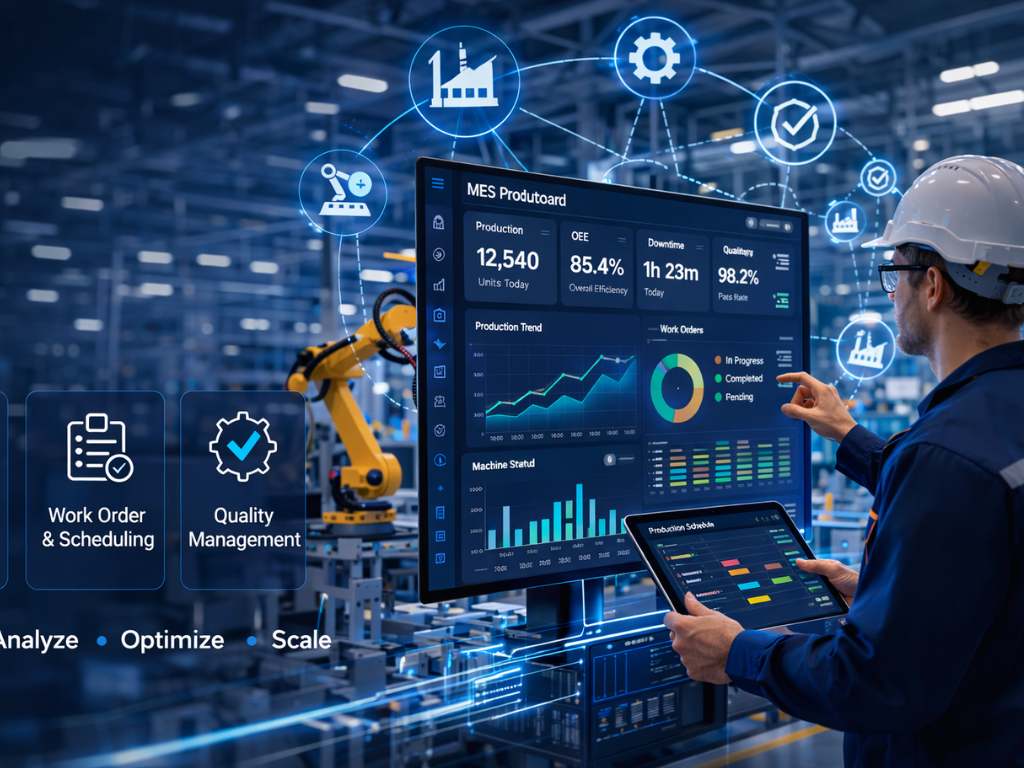
One of the most significant advantages of manufacturing software is real-time visibility into shop-floor activities. Managers can track machine performance, work orders, and production status through live dashboards. Consequently, issues such as delays or equipment failures can be identified and resolved quickly.
Workflow Automation
Manual processes often lead to errors and inefficiencies. Manufacturing software automates routine tasks such as job scheduling, data entry, and reporting. Therefore, teams can focus on higher-value activities while ensuring consistency and accuracy across operations.
Improved Quality Management
Maintaining consistent product quality becomes easier with built-in quality control features. Manufacturing software standardises processes, integrates inspection checks, and enables full traceability. As a result, defects are reduced, and compliance requirements are easier to meet.
Better Resource Utilisation
Efficient use of resources is essential for productivity. Manufacturing software provides insights into how labour, machines, and materials are being used. Consequently, manufacturers can optimise resource allocation, reduce waste, and maximise output.
Faster and Smarter Decision-Making
With access to real-time data and performance analytics, decision-makers can respond quickly to changing conditions. Instead of relying on assumptions, they can use accurate insights to improve workflows, reduce downtime, and enhance overall efficiency.
Overall, manufacturing software enables organisations to move from reactive operations to proactive management, ensuring better production control and continuous improvement across the manufacturing process.
Key Features of Manufacturing Software
Manufacturing software offers a range of features designed to streamline production processes, improve visibility, and enhance overall operational control. By integrating multiple functions into a single platform, it enables manufacturers to manage complex workflows more efficiently. As a result, organisations can achieve higher productivity and better decision-making.
Production Tracking and Scheduling
Manufacturing software allows businesses to monitor work orders, track production progress, and manage schedules in real time. This ensures that tasks are completed on time and resources are allocated effectively. Consequently, production delays are minimised, and efficiency improves.
Performance Analytics and Reporting
Advanced dashboards and reporting tools provide insights into key performance indicators such as cycle time, throughput, and equipment efficiency. By analysing this data, manufacturers can identify bottlenecks and continuously optimise operations.
Inventory and Material Management
Managing inventory is critical to maintaining smooth production flows. Manufacturing software tracks material usage, stock levels, and supply requirements, ensuring that the right materials are available when needed. Therefore, it reduces both shortages and excess inventory.
Quality Control Integration
Quality management features are integrated directly into production workflows. The system records inspection data, monitors compliance, and ensures traceability. As a result, manufacturers can maintain consistent product quality while reducing defects and rework.
Machine and IoT Connectivity
Modern manufacturing software can connect directly with machines and Industrial IoT devices. This enables automatic data collection, improving accuracy and providing real-time insights into equipment performance and production status.
Workflow and Process Automation
Automation of routine tasks such as data entry, reporting, and task assignments helps reduce manual effort and human error. Consequently, workflows become more efficient, and teams can focus on strategic activities.
Together, these features demonstrate how manufacturing software creates a connected and intelligent production environment, enabling manufacturers to improve efficiency, maintain control, and drive continuous improvement.
Types of Manufacturing Software
Manufacturing software includes a range of systems designed to support different aspects of production and business operations. While each type serves a specific purpose, they often work together to create a fully connected manufacturing environment. Therefore, understanding these systems helps manufacturers choose the right solution based on their operational needs.
Manufacturing Execution Systems (MES)
MES focuses on real-time production control and shop-floor management. It tracks work orders, monitors machine performance, and provides live insights into production activities. As a result, manufacturers can improve efficiency, reduce downtime, and maintain better control over operations.
Enterprise Resource Planning (ERP) Systems
ERP systems manage business-level processes such as finance, procurement, inventory planning, and order management. Unlike MES, which operates on the shop floor, ERP provides a high-level view of business operations. Consequently, it helps organisations plan resources and align production with demand.
Quality Management Software (QMS)
QMS solutions are designed to ensure product quality and regulatory compliance. They manage inspections, track defects, and maintain detailed records for audits. Therefore, manufacturers can standardise quality processes and reduce errors across production.
Inventory Management Systems
Inventory management software helps track raw materials, components, and finished goods. It ensures that materials are available when needed while avoiding overstocking. As a result, manufacturers can maintain efficient supply chains and reduce storage costs.
Production Planning and Scheduling Software
This type of software focuses on optimising production schedules and resource allocation. It helps manufacturers plan workflows, minimise delays, and improve overall efficiency. Consequently, production processes become more organised and predictable.
Manufacturing Software vs Traditional Systems
Comparing manufacturing software with traditional methods highlights the significant advantages of digital transformation in modern production environments. While many manufacturers still rely on spreadsheets, paper-based processes, or disconnected tools, these approaches often limit efficiency, accuracy, and scalability. In contrast, manufacturing software provides a more structured and data-driven way to manage operations.
Manual Processes vs Automated Workflows
Traditional systems depend heavily on manual data entry, which increases the risk of human error and delays. Manufacturing software, however, automates routine tasks such as scheduling, reporting, and data collection. As a result, operations become faster, more consistent, and less prone to mistakes.
Limited Visibility vs Real-Time Insights
With traditional methods, production data is often updated periodically, making it difficult to track performance in real time. Consequently, managers may struggle to respond quickly to issues. Manufacturing software provides live dashboards and instant updates, enabling faster decision-making and better operational control.
Disconnected Systems vs Integrated Operations
In many traditional setups, production, inventory, and quality data are stored in separate systems. This lack of integration creates data silos and inefficiencies. In contrast, manufacturing software connects these functions into a unified platform, ensuring seamless communication and improved coordination across departments.
Reactive Management vs Proactive Optimisation
Traditional systems often lead to reactive problem-solving, where issues are addressed only after they occur. Manufacturing software, on the other hand, uses real-time data and analytics to identify potential problems early. Therefore, manufacturers can take proactive steps to prevent disruptions and optimise performance.
Scalability Limitations vs Growth Enablement
As businesses grow, traditional systems become increasingly difficult to manage. They lack the flexibility needed to handle larger volumes and more complex operations. Manufacturing software is designed to scale with the organisation, supporting expansion without compromising efficiency.
Benefits of Manufacturing Software
Implementing manufacturing software provides a wide range of benefits that directly impact productivity, cost efficiency, and overall operational performance. By connecting processes and enabling real-time insights, manufacturers can move beyond manual limitations and achieve more consistent and scalable outcomes. As a result, businesses are better equipped to compete in an increasingly digital and fast-paced market.
Increased Productivity
Manufacturing software streamlines workflows and reduces manual intervention, allowing teams to complete tasks more efficiently. Consequently, production output increases without requiring additional resources.
Reduced Operational Costs
By minimising waste, optimising inventory levels, and improving resource utilisation, manufacturing software helps lower operational expenses. Additionally, fewer errors and reduced rework contribute to significant cost savings.
Improved Product Quality
Integrated quality control features ensure that processes are standardised and monitored throughout production. As a result, manufacturers can maintain consistent product quality while reducing defects and compliance risks.
Enhanced Visibility and Control
With real-time dashboards and reporting tools, manufacturing software provides complete visibility into production activities. Therefore, managers can track performance, identify issues quickly, and maintain better control over operations.
Better Decision-Making
Access to accurate and up-to-date data enables manufacturers to make informed decisions. Instead of relying on assumptions, businesses can use insights to optimise workflows and improve efficiency.
Improved Compliance and Traceability
Manufacturing software records detailed production data, making it easier to meet regulatory requirements and conduct audits. In addition, full traceability helps identify and resolve quality issues more effectively.
Scalability for Business Growth
As manufacturing operations expand, software solutions can scale to handle increased complexity. This ensures that businesses can grow without losing efficiency or control over their processes.
How to Choose the Right Manufacturing Software
Choosing the right manufacturing software is a critical decision that can significantly impact operational efficiency, scalability, and long-term business success. With a wide range of solutions available, manufacturers must carefully evaluate their needs and select a system that aligns with their production goals. Therefore, taking a structured approach to selection ensures better outcomes and smoother implementation.
Identify Your Business Requirements
Start by defining your specific challenges and objectives. For example, you may need to improve production tracking, enhance quality control, or optimise inventory management. Clearly understanding these needs helps narrow down the most suitable manufacturing software solutions.
Evaluate Integration Capabilities
Manufacturing software should integrate seamlessly with your existing systems, such as ERP, MES, or inventory management tools. Strong integration ensures smooth data flow, reduces manual work, and improves overall efficiency.
Consider Scalability and Flexibility
As your business grows, your software should be able to handle increased production complexity. Therefore, choose a solution that can scale with your operations and adapt to changing requirements without major disruptions.
Assess Ease of Use and Adoption
A user-friendly interface is essential for successful implementation. If the system is too complex, employees may resist using it. Consequently, selecting intuitive software can improve adoption rates and ensure consistent usage across teams.
Check Real-Time Capabilities
Real-time data is crucial for modern manufacturing. Ensure that the software provides live insights into production, inventory, and performance so that decisions can be made quickly and accurately.
Evaluate Customisation Options
Every manufacturing environment is different. Therefore, the ability to customise workflows, reports, and features ensures the software aligns with your specific processes and operational needs.
Cloud vs On-Premise Deployment
Decide whether you need a cloud-based solution or an on-premise system. Cloud software offers flexibility, scalability, and remote access, while on-premise solutions may provide greater control over data and infrastructure.
Review Vendor Support and Expertise
Reliable support is essential for long-term success. Choose a vendor with industry experience, strong customer support, and a proven track record in manufacturing software solutions.
Real-World Use Cases of Manufacturing Software
Manufacturing software is used across a wide range of industries to improve efficiency, enhance quality, and streamline production processes. While each manufacturing environment has unique requirements, the core objective remains the same — to gain better control, visibility, and optimisation of operations. As a result, businesses across different sectors are leveraging manufacturing software to solve real-world challenges.
Discrete Manufacturing
Industries such as automotive, electronics, and machinery production rely on assembling individual components into finished products. Manufacturing software helps track each stage of the assembly process, manage work orders, and ensure quality checks are completed accurately. Consequently, manufacturers can reduce errors, improve throughput, and maintain product consistency.
Process Manufacturing
Sectors like food and beverage, pharmaceuticals, and chemicals operate with continuous or batch production processes. Manufacturing software enables real-time monitoring of production parameters, ensuring consistency and compliance with regulatory standards. Therefore, manufacturers can maintain quality while reducing waste and production variability.
High-Mix, Low-Volume Production
Manufacturers producing customised products or frequently changing designs face challenges in scheduling and workflow management. Manufacturing software provides flexibility by enabling real-time updates and dynamic production planning. As a result, businesses can adapt quickly to changing customer demands without compromising efficiency.
Multi-Site Manufacturing Operations
Companies operating across multiple facilities require centralised visibility and standardised processes. Manufacturing software consolidates data from different locations into a single platform, allowing better coordination and performance tracking across all sites.
Inventory and Supply Chain Optimisation
Manufacturing software helps manage material flow, track inventory levels, and forecast demand more accurately. This ensures that materials are available when needed while avoiding overstocking or shortages, leading to more efficient supply chain management.
Quality and Compliance Management
In industries with strict regulatory requirements, manufacturing software supports compliance by maintaining detailed records, tracking inspections, and ensuring traceability. Consequently, businesses can simplify audits and maintain high-quality standards.
Future Trends in Manufacturing Software
As technology continues to evolve, manufacturing software is becoming more advanced, intelligent, and interconnected. These innovations are reshaping how manufacturers operate, enabling greater efficiency, flexibility, and data-driven decision-making. Consequently, businesses that adopt emerging trends early will be better positioned to stay competitive in a rapidly changing industrial landscape.
Artificial Intelligence and Machine Learning
AI and machine learning are transforming manufacturing software by enabling predictive analytics and automated decision-making. These technologies can analyse large volumes of production data to identify patterns, forecast demand, and predict equipment failures. As a result, manufacturers can move from reactive operations to proactive optimisation.
Automation and Robotics Integration
Manufacturing software is increasingly integrated with automation systems and robotics. This allows for seamless coordination between digital systems and physical operations, improving productivity and reducing human error. Therefore, manufacturers can achieve faster and more consistent production outcomes.
Industrial Internet of Things (IIoT)
The integration of IIoT devices enables manufacturing software to collect real-time data directly from machines and sensors. This connectivity provides deeper insights into equipment performance and production processes, helping manufacturers optimise operations and reduce downtime.
Cloud-Based Manufacturing Software
Cloud technology is becoming a standard for modern manufacturing software. It offers scalability, remote access, and faster deployment compared to traditional on-premise systems. Additionally, cloud-based solutions allow manufacturers to manage operations across multiple locations from a single platform.
Digital Twins and Simulation
Digital twin technology creates virtual replicas of physical production systems. When combined with manufacturing software, it allows manufacturers to simulate processes, test changes, and optimise workflows without disrupting actual operations.
Enhanced Data Analytics and Visualisation
Advanced analytics tools provide deeper insights into production performance, enabling manufacturers to identify inefficiencies and improve decision-making. Visual dashboards make complex data easier to understand and act upon.
Focus on Sustainability and Efficiency
Sustainability is becoming a key priority in manufacturing. Modern software solutions help track energy consumption, reduce waste, and optimise resource usage. As a result, manufacturers can meet environmental goals while improving operational efficiency.
FAQs
What is manufacturing software?
Manufacturing software is a digital solution used to manage, monitor, and optimise production processes. It helps manufacturers track operations, manage inventory, improve quality control, and gain real-time insights into performance.
How does manufacturing software improve efficiency?
Manufacturing software improves efficiency by automating workflows, providing real-time data, and reducing manual errors. As a result, manufacturers can streamline operations, minimise downtime, and make faster, data-driven decisions.
What types of manufacturing software are available?
Common types include Manufacturing Execution Systems (MES), Enterprise Resource Planning (ERP) systems, Quality Management Systems (QMS), and inventory management software. Each serves a specific role in managing production and business operations.
Is manufacturing software suitable for small businesses?
Yes, modern manufacturing software is scalable and can be tailored to the needs of small and mid-sized manufacturers. It helps improve efficiency, reduce errors, and support business growth without requiring complex infrastructure.
How much does manufacturing software cost?
The cost varies depending on features, deployment type (cloud or on-premise), and business size. Many providers offer flexible pricing models, allowing manufacturers to choose solutions that fit their budget and requirements.
Can manufacturing software integrate with existing systems?
Most manufacturing software solutions are designed to integrate with existing systems such as ERP, MES, and IoT devices. This ensures seamless data flow and improves overall operational efficiency.
What are the key features to look for in manufacturing software?
Important features include real-time production monitoring, workflow automation, inventory management, quality control, analytics, and system integration capabilities.
How long does it take to implement manufacturing software?
Implementation time depends on the complexity of operations and the chosen solution. It can range from a few weeks for smaller setups to several months for large-scale deployments.
Conclusion: Transforming Manufacturing with the Right Software
In an increasingly competitive and fast-paced industrial landscape, adopting the right manufacturing software is no longer optional—it is essential for long-term success. As manufacturers face growing pressure to improve efficiency, reduce costs, and maintain high-quality standards, digital solutions provide the tools needed to stay ahead.
Throughout the production lifecycle, manufacturing software enables real-time visibility, streamlined workflows, and data-driven decision-making. By replacing manual processes with connected systems, organisations can minimise errors, reduce downtime, and optimise resource utilisation. As a result, operations become more efficient, scalable, and resilient.
Moreover, as technologies such as AI, automation, and Industrial IoT continue to evolve, manufacturing software will play an even greater role in shaping the future of production. Businesses that embrace these innovations early will be better positioned to adapt to market changes and drive continuous improvement.
Ultimately, investing in manufacturing software empowers manufacturers to enhance productivity, improve product quality, and build a strong foundation for sustainable growth in a digital-first world.