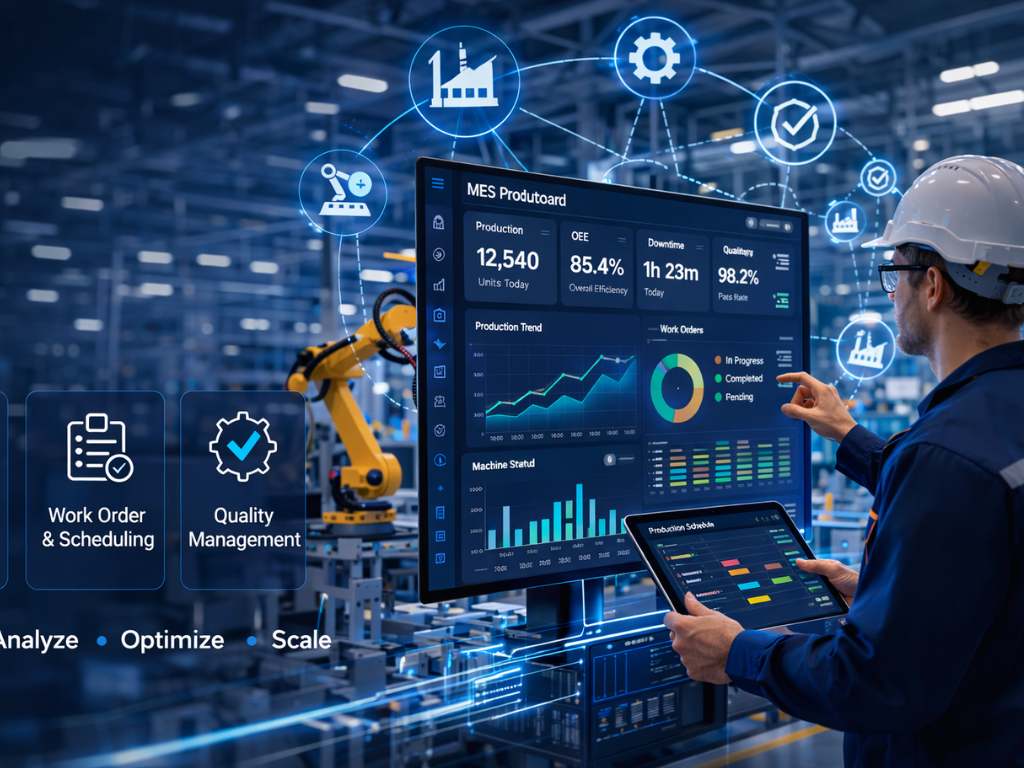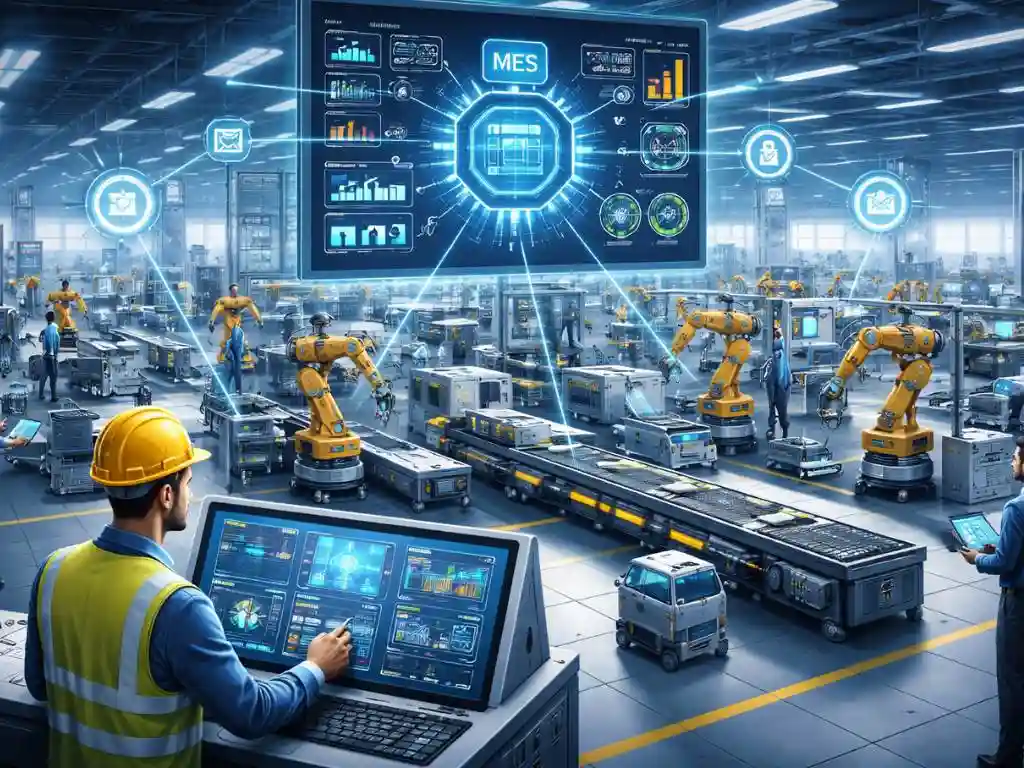
Paperless manufacturing is a digital approach that replaces manual paperwork with real-time data, automation, and connected systems. It helps manufacturers improve efficiency, reduce errors, and gain complete visibility across production processes.
What Is Paperless Manufacturing?
Paperless manufacturing is a digital approach to production that replaces manual paperwork with electronic systems, real-time data, and automated workflows. Instead of relying on paper-based records such as work orders, checklists, and quality forms, manufacturers use software solutions to manage and track operations across the shop floor.
By integrating technologies such as Manufacturing Execution Systems (MES), IoT devices, and cloud-based platforms, paperless manufacturing enables seamless data collection and communication between machines, operators, and management systems. As a result, information is captured instantly, reducing errors caused by manual entry and improving overall accuracy.
In essence, paperless manufacturing creates a connected and transparent production environment where processes are standardised, decisions are data-driven, and operations are more efficient. This shift not only enhances productivity but also supports compliance, traceability, and continuous improvement in modern manufacturing.
How Paperless Manufacturing Works
Paperless manufacturing works by replacing manual, paper-based processes with digital systems that capture, manage, and share production data in real time. Instead of relying on printed work orders, checklists, and reports, manufacturers use connected technologies to streamline workflows and improve operational visibility.
Digital Work Instructions and Workflows
In a paperless environment, traditional documents such as job sheets, SOPs, and inspection forms are converted into digital formats. Operators access these instructions through tablets, mobile devices, or shop-floor terminals. As a result, processes become standardised, and the risk of human error is significantly reduced.
Real-Time Data Collection
Machines, sensors, and operators continuously generate data during production. This data is automatically captured through integrated systems, eliminating the need for manual entry. Consequently, manufacturers gain instant visibility into production performance, machine status, and quality metrics.
Integration with MES and ERP Systems
Paperless manufacturing relies on seamless integration between systems such as MES (Manufacturing Execution Systems) and ERP platforms. While ERP manages planning and resources, MES ensures real-time execution on the shop floor. Together, they create a connected ecosystem where data flows smoothly across departments.
Automation of Quality and Compliance Processes
Quality checks, inspections, and compliance records are digitised and automated. Instead of filling out paper forms, operators record results directly into the system. This ensures accurate documentation, simplifies audits, and improves traceability.
Centralised Data and Analytics
All production data is stored in a central system, allowing managers to analyse performance and identify trends. With access to real-time dashboards and reports, decision-makers can quickly address inefficiencies and optimise operations.
Improved Communication and Collaboration
Digital systems enable better communication between teams by providing instant access to up-to-date information. This reduces delays, eliminates miscommunication, and ensures that everyone is aligned with production goals.
Benefits of Paperless Manufacturing
Paperless manufacturing enables organisations to replace manual, paper-based processes with digital systems that provide real-time data, automation, and improved operational control. As manufacturers strive to increase efficiency and reduce costs, adopting a paperless approach delivers significant advantages across the entire production lifecycle.
Improved Operational Efficiency
By eliminating manual paperwork, manufacturers can streamline workflows and reduce time spent on data entry and documentation. As a result, processes become faster, more consistent, and less prone to delays.
Real-Time Visibility and Decision-Making
Paperless manufacturing provides instant access to production data, allowing managers to monitor operations as they happen. Consequently, issues can be identified and resolved quickly, enabling faster and more informed decision-making.
Reduced Errors and Increased Accuracy
Manual processes often lead to data entry mistakes and inconsistencies. Digital systems minimise human error by automating data capture and standardising workflows. Therefore, product quality and process accuracy improve significantly.
Enhanced Traceability and Compliance
With digital records, manufacturers can track every stage of production, from raw materials to finished goods. This ensures better traceability and simplifies compliance with industry regulations and audit requirements.
Cost Reduction
Paperless manufacturing reduces costs associated with printing, storage, and manual labour. In addition, improved efficiency and reduced errors lead to lower operational expenses over time.
Better Collaboration and Communication
Digital platforms enable seamless communication between teams, departments, and locations. As a result, information is shared instantly, improving coordination and reducing misunderstandings.
Improved Quality Control
Real-time monitoring and automated quality checks help detect issues early in the production process. Consequently, manufacturers can reduce defects, minimise rework, and maintain consistent product quality.
Support for Smart Manufacturing and Industry 4.0
Paperless manufacturing is a key component of smart factories. By integrating with technologies such as MES, IoT, and automation systems, it enables a connected and data-driven production environment.
Challenges of Going Paperless
While paperless manufacturing offers significant efficiency and visibility benefits, transitioning from traditional paper-based processes to digital systems is not without challenges. Manufacturers must carefully plan and address these obstacles to ensure a smooth and successful transformation. However, with the right strategy and tools, these challenges can be effectively managed.
Initial Implementation Costs
One of the primary concerns is the upfront investment required for software, hardware, and system integration. Although paperless systems deliver long-term cost savings, the initial expense can be a barrier for some manufacturers. Therefore, businesses need to evaluate return on investment and adopt a phased implementation approach.
Resistance to Change
Employees who are accustomed to manual processes may be hesitant to adopt new digital systems. This resistance can slow down implementation and reduce adoption rates. As a result, proper training and change management strategies are essential to ensure a smooth transition.
System Integration Complexity
Integrating paperless solutions with existing systems such as ERP, MES, and legacy equipment can be challenging. Without seamless integration, data silos may persist. Consequently, manufacturers must choose solutions that support flexible and scalable integration.
Data Security and Compliance Concerns
Moving to digital systems increases the importance of data security. Manufacturers must ensure that sensitive production and operational data is protected from cyber threats while meeting industry compliance requirements.
Training and Skill Gaps
Adopting new technology requires employees to learn new tools and workflows. In many cases, skill gaps can impact productivity during the transition period. Therefore, ongoing training and support are crucial for long-term success.
Dependence on Technology
A fully paperless environment relies heavily on digital systems and infrastructure. Any system downtime or technical issue can disrupt operations if proper backup and contingency plans are not in place.
Process Standardisation Requirements
Before going paperless, manufacturers must standardise their processes. Digitising inefficient or inconsistent workflows can amplify existing problems rather than solve them. Hence, process optimisation should be a priority before implementation.
Paperless Manufacturing Myths
ProcessIQ’s Manufacturing Execution System (MES) and digital work instructions are specifically designed to address these concerns while delivering measurable improvements in efficiency, quality, and traceability. In this blog, we’ll dismantle the five most persistent myths about paperless manufacturing and demonstrate how ProcessIQ provides a practical, cost-effective path forward.
Myth #1: “Going Paperless Is Too Expensive”
Many manufacturers assume that transitioning to a digital system requires a prohibitive upfront investment. While there are certainly costs associated with implementation, this perspective overlooks the substantial—and often hidden—expenses of sticking with paper.
Consider the ongoing costs of printing, storing, and distributing paper documents. Add in the time wasted searching for lost or outdated instructions, the cost of errors caused by misread or missing information, and the inefficiencies of manual data entry. Suddenly, the true price of paper becomes clear.
ProcessIQ eliminates these hidden costs by providing a scalable platform that centralises all work instructions and production and quality data. Dynamic digital work instructions ensure operators only have the latest revision at their fingertips, eliminating very costsly re-work. Reporting and analytics helps identify quality and production issues, reducing waste and improving productivity. Over time, these savings far outweigh the initial investment.
Real-World Impact: ProPhotonix saves significant administrative time by implementing ProcessIQ paperless work instruction software
“20 minutes per day has been saved in administration – copy/pasting, tracking documents, getting sign off…ProcessIQ has enabled us to create work instruction documentation much more quickly.”
Myth #2: “Digital Systems Are Too Complex for Our Workforce”
A common fear is that shop-floor employees—particularly those less familiar with technology—will struggle to adapt to a digital system. This concern stems from outdated perceptions of clunky poorly designed software.
Modern digital work instruction platforms, like ProcessIQ, are designed with the end user in mind. The interface is intuitive and visual, incorporating images, videos, and step-by-step guides that are easier to follow than dense paper manuals. Role-based access ensures that each worker sees only the information relevant to their tasks, removing ambiguity.
Additionally, operators can view instructions directly on the shop floor, whether on tablets, or workstation monitors. Training time is minimal because the system is built for ease of use.
Customer Insight: “Our team—including veteran operators with decades of experience—adapted to ProcessIQ faster than we expected. The visual guides made the transition seamless.” — defence manufacturing customer.
Myth #3: “We’ll Lose Flexibility with Digital Systems”
High-mix, low volume manufacturers, in particular, worry that digital systems will add constraints, locking in rigid processes, making it harder to accommodate variability.
In reality, digital systems enhance flexibility. Paper-based systems require manual updates, leading to version control issues and production delays. ProcessIQ, by contrast, allows for instant updates across all workstations the moment an engineering change is embodied into the latest revision. Robust version and revision control ensures that every operator is using the correct revision, eliminating quality issues and costly re-work.
ProcessIQ’s dynamic workflows enhances efficiency further by automatically adjusting work instructions and quality data inputs, based on variances in product configuration . This adaptability is especially valuable in industries like electronic packaged goods such as lasers or defence, where process development can we complex and subject to change.
Measurable Results: Grass Valley had a mountain to climb moving 900+ assembly procedures to a new work instructions solution. Yet in under a year, the company has migrated 90% of its procedures to ProcessIQ, improving quality and making significant time savings.
Myth #4: “Paper Is More Reliable Than Digital”
Whilst some manufacturers cling to paper because it feels tangible and familiar— in practice, paper is far from reliable. Attributable, Contemperanous, Original, Accurate, complete, consistent & enduring data is what is required to meet industry standards.
Papers can go missing, get damaged, become illegible and a signiifcant problem is the ability to write down critical quality data later, en-mass, not in a contemperanous manner, meaning at the time results or data was available. Handwritten notes introduce inconsistencies, and outdated instructions lead to costly rework. Digital systems, on the other hand, provide always-accessible, up-to-date instructions with built-in error-proofing and the enforcement of quality data capture at the time of being able to enter it.
ProcessIQ enhances reliability with:
- Centralised digital work instructions have quality in-built with both the process and quality inputs.
- Audit trails from revisions to work orders and build history tracks every change for full traceability.
- Automated verification (e.g., barcode scanning) to ensure the right parts and processes are used.
Industry Data: Companies using digital work instructions report 50% fewer documentation-related defects, significantly reducing scrap and rework costs.
Myth #5: “Cybersecurity Risks Outweigh the Benefits”
With increasing cyber threats, some manufacturers worry that digital systems expose them to greater risk than paper. However, paper documents are far more vulnerable to loss, theft, or unauthorised access.
ProcessIQ prioritises security with:
- Enterprise-grade data standards to ensure IP cannot be accessed by bad actors .
- Role-based permissions to restrict sensitive information.
- Compliance-ready features that underpin industry standards and protocols
Unlike paper, digital systems provide detailed audit logs, ensuring accountability and simplifying compliance reporting.
Customer Example:
A defence electronic manufacturer said that
“Auditors have been incredibly impressed by our detailed procedures and extensive version controls, right down to the ‘Bill of Material’. In fact, because our high audit scores are inserted into vendors’ databases, this has meant we have been identified for other contracts and have the potential to win new business“
How ProcessIQ Enables Paperless Manufacturing
Transitioning to paperless manufacturing requires more than simply digitising documents—it demands a fully connected system that captures, processes, and delivers real-time production data across the entire shop floor. This is where ProcessIQ plays a critical role by enabling manufacturers to replace manual, paper-based processes with intelligent digital workflows.
Real-Time Data Capture and Visibility
ProcessIQ connects directly with machines, operators, and production systems to capture data in real time. Instead of relying on paper logs or manual reporting, manufacturers gain instant visibility into production performance, quality metrics, and operational status. As a result, decision-making becomes faster and more accurate.
Digital Workflows and Instructions
Paper-based work instructions often lead to inconsistencies and errors. ProcessIQ replaces these with standardised digital workflows that guide operators step by step. Consequently, processes become more consistent, reducing variability and improving overall production quality.
Automated Data Collection and Reporting
Manual data entry is time-consuming and prone to errors. With ProcessIQ, data is automatically collected and stored, eliminating the need for paperwork. In addition, automated reporting provides actionable insights, helping teams identify inefficiencies and optimise operations continuously.
Improved Quality Control and Traceability
ProcessIQ integrates quality checks directly into the production process, ensuring that issues are detected early. Every action is recorded digitally, creating a complete audit trail for compliance and traceability. Therefore, manufacturers can maintain high standards while reducing defects and rework.
Seamless Integration with Existing Systems
To enable true paperless manufacturing, ProcessIQ integrates with MES, ERP, and other enterprise systems. This ensures smooth data flow between planning and execution, eliminating data silos and improving coordination across departments.
Enhanced Efficiency and Reduced Costs
By eliminating paper-based processes, ProcessIQ reduces administrative workload, minimises errors, and accelerates production cycles. As a result, manufacturers can lower operational costs while improving efficiency and productivity.
FAQs
What is paperless manufacturing?
Paperless manufacturing refers to eliminating physical paperwork and replacing it with digital systems for tracking, planning, executing, and analyzing production processes. It improves accuracy, traceability, and collaboration across the shop floor.
What are common myths about paperless manufacturing?
Common myths include beliefs that paperless manufacturing is too complex, expensive, only for large manufacturers, causes disruption, or replaces human workers entirely. These misconceptions overlook modern solutions like ProcessIQ that make digital transformation accessible and practical for all sizes of manufacturing operations.
How does paperless manufacturing software benefit production efficiency?
Paperless manufacturing software automates data capture, streamlines work instructions, eliminates manual errors, and speeds up communication. This leads to faster cycle times, fewer quality issues, better resource utilization, and improved shop floor visibility.
Does process intelligence play a role in paperless manufacturing?
Yes. Process intelligence platforms — like ProcessIQ — analyze actual production data and workflows to provide actionable insights. This helps manufacturers understand bottlenecks, optimize processes, and make the most of their paperless manufacturing efforts.
Is paperless manufacturing only for large enterprises?
No. Modern paperless manufacturing solutions are scalable and affordable for manufacturers of all sizes. With tools like ProcessIQ, small and medium manufacturers can adopt digital production practices without significant disruption or heavy investment.
How does ProcessIQ solve common paperless manufacturing challenges?
ProcessIQ addresses common challenges by providing centralized digital work instructions, real-time production visibility, automated process tracking, and performance analytics. It simplifies implementation and accelerates adoption of paperless workflows on the shop floor.
Will paperless manufacturing improve quality control?
Absolutely. By replacing manual logs and paper checklists with digital systems, manufacturers get accurate, real-time quality data, standardized procedures, and automated alerts. This leads to fewer defects, faster corrective actions, and better compliance.
How does paperless manufacturing impact audit readiness and compliance?
Digital records created through paperless manufacturing systems are easier to access, review, and secure. This improves traceability, supports audit readiness, and reduces the risk of non-compliance with industry standards and regulations.
Is paperless manufacturing expensive?
Paperless manufacturing is not necessarily expensive—it is a long-term investment that often reduces overall operational costs. While there may be initial setup expenses for software and implementation, businesses quickly benefit from lower paper usage, fewer errors, reduced waste, and improved efficiency. As a result, most manufacturers achieve a strong return on investment over time.
How does MES support paperless manufacturing?
A Manufacturing Execution System (MES) supports paperless manufacturing by replacing manual, paper-based processes with real-time digital workflows. It collects data directly from machines and operators, eliminating the need for physical records and manual data entry.
By providing digital work instructions, automated data capture, and real-time production visibility, MES ensures accurate and consistent operations across the shop floor. As a result, manufacturers can reduce errors, improve efficiency, and maintain complete traceability without relying on paper documents.
Conclusion: Why Paperless Manufacturing Is the Future
Paperless manufacturing is no longer a trend—it is a necessity for businesses aiming to stay competitive in a digital-first world. By replacing manual processes with connected, data-driven systems, manufacturers can improve efficiency, enhance quality, and achieve greater operational control.
Organisations that embrace paperless manufacturing today will be better positioned to scale, innovate, and succeed in the future of smart manufacturing.
The question isn’t whether you can afford to go digital—it’s whether you can afford not to.
Ready to experience the benefits firsthand? Schedule a demo with ProcessIQ today.